
By guest poster Gary Farber.
I don't have one of those. Sorry.
But, hey, it's Labor Day weekend, and so a post of silly or unusual links, and open-threadedness for all!
This first one you just have to trust me on: A Periodic Table Of Visualization Methods. This sounds incredibly dull, but is immensely cool. Check out the interactivity that a screen shot could barely hint at.
Don't like that one? Use The Periodic Table Of Swearing. (Should not be viewed by anyone offended by naughty words. Really.)
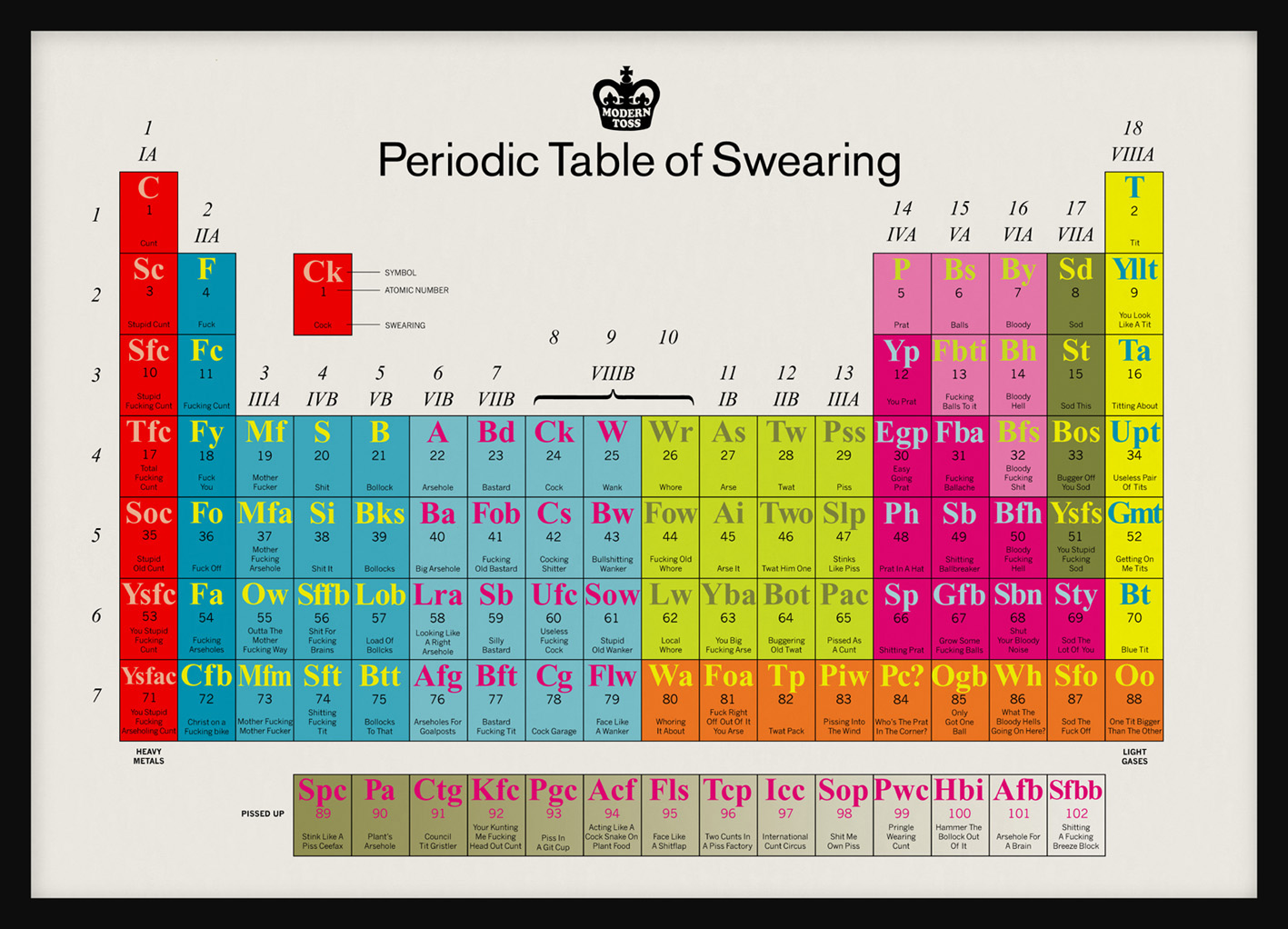
(UPDATE: link fixed. Originally from Modern Toss.)
How about an actually useful Table Of Condiments and their spoilage?
The Periodic Table Of Candy. The Periodic Table Of Awesoments. (Hey, it's not my title.) The Periodic Table Of Rejected Elements. And finally, The Wooden Periodic Table Table.
But we need more visualizations! A metrocontextual science map (original here), which is to say, in the form of a London Underground map.
Want your own Homebrew Cray-1A supercomputer?
What is this bad boy running? The original machine ran at a blistering 80 MHz,
and could use from 256-4096 kilowords (32 megabytes!) of memory. It has 12
independent, fully-pipelined execution units, and with the help of clever
programming, can peak at 3 floating-point operations per cycle.
From 1976-82, the fastest computer in the world.
You've probably heard that Moore's Law is still apparently in effect.
Font design matters a great deal more than many people think.
As Cavs owner Dan Gilbert can
attest, using Comic Sans leads to people not taking you seriously.
Researchers at Carnegie Mellon have discovered that the loopy font also helps to
get people to let down their privacy guard online.[…]
To encourage students to loosen up and be more forthcoming about their
substance abuse, sexual activity, and illegal acts, all the researchers had to
do was replace the Carnegie Mellon University seal with a cartoon devil and use
a Comic Sans font…
By changing the title of the page from “Carnegie Mellon University Executive
Council Survey on Ethical Behaviors” to “How BAD Are U???”, adding some stock
art and using Comic Sans as the font, the researchers got much more candid answers:But when the Web site was colorful and blurry, and the survey was introduced
by a red devil’s head and the words “How BAD Are U???”, the students were far
more likely to say they had taken part in nefarious activities. The students,
however, conceded that the unprofessional Web site seemed to be a far less safe
place to give revelatory information.Apparently, because the “How BAD Are You?” site was goofy, the college
students assumed that the people behind it were equally goofy and would not
abuse the data (or look askance at it the same way that university researchers
would).
Design always matters. It can even make us talk to our computers.
[…] To have Clippy learn about his users would have required advanced artificial
intelligence technology, along with a great deal of design and development time.
An alternate approach is to use a social strategy. The simplest and most
effective way for dislikable people to become more accepted is for them to find
a scapegoat.In an experiment, we revised Clippy so that when he made a suggestion or
answered a question, he would ask, "Was that helpful?" and then present buttons
for "yes" and "no." If the user clicked "no," Clippy would say, "That gets me
really angry! Let's tell Microsoft how bad their help system is." He would then
pop up an email to be sent to "Manager, Microsoft Support," with the subject,
"Your help system needs work!" After giving the user a couple of minutes to type
a complaint, Clippy would say, "C'mon! You can be tougher than that. Let 'em
have it!"The system was showed to 25 computer users, and the results were unanimous:
People fell in love with the new Clippy. A long-term business user of Microsoft
Office exclaimed, "Clippy is awesome!" An avowed "Clippy hater" said, "He's so
supportive!"Without any fundamental change in the software, the right social strategy
rescued Clippy from the list of Most Hated Software of all time; creating a
scapegoat bonded Clippy and the user against a common enemy.
Since this is not a political post, I naturally make no comment about contemporary political scapegoating.
From the same article, though, observations on how to comment on blogs:
[…] During one demonstration, the participant exceeded the speed limit and made a
turn a little too sharply. "You are not driving very well," the car said.
"Please be more careful."The driver was not delighted to hear this valuable information from an
impartial source; instead, he became somewhat annoyed. He started to over-steer,
making rapid, small adjustments to the wheel; the system reported an increase in
driving speed and a decrease in driving distance from the next car. "You are
driving quite poorly now," the car announced. "It is important that you drive
better."Was the driver now appropriately chastened? No. His face contorted in anger
as he started driving even faster, darting from lane to lane without signaling.
He swerved back and forth from one side of the lane to the other at a
frightening pace, tailgating the cars in front of him. This spiral of negative
evaluation, anger, worse driving and more negative evaluation escalated until,
in a rage, he smashed into another car in the simulation.Trying to cheer up unhappy drivers by giving a car an enthusiastic voice, on
the theory that "misery loves company," doesn't work either. It turns out that
the correct saying is "misery loves miserable company." When you're angry, there
are few things worse than having someone bounce in and say, "Let's turn that
frown upside down!" A much better strategy is to sound negative and subdued,
thereby being sympathetic while reducing the driver's arousal.
Sorry, did I write "blogs"? This advice on feedback from cars couldn't possibly apply to how we might choose to give feedback in blog comments!
Clifford Nass's conclusion includes this:
We now see software that is superior to all but the most suave people with
respect to effective praising and criticizing [….]
I find this plausible.
I also find it plausible that the following works for blogging, as well as in academia: An analysis of over 50,000 Science papers suggests that it could pay to include more references.
Refer, and be referred back to.
You could even make a game out of it in social media.

I could have told you that when I was 12, doing science fiction fanzines. Speaking of which, here are your Hugo Awards, freshly baked.
And if you like science fiction remotely, you may wish to read William H. Patterson's Robert A. Heinlein In Dialogue with His Century: Volume 1 (1907-1948): Learning Curve, which explores not just Heinlein, but his effect on our world, with immense biographical detail. A review. Michael Dirda. John Clute.
I should disclose that Bill and I have been good friends since 1978, and I read several thousands of pages of earlier draft of this book, giving Bill hundreds of notes on it, in 2006-7, so I am not without — what's the word? — bias.
But I guarantee you that no matter how much you think you know about Robert Heinlein, you'll find much to surprise, if not astonish, you in this terrific biography. And, no, if you hate him, don't read it.
Happy Labor Day, if you're an American.
And if you fear at any time an al Qaeda or Iranian nuclear attack, find a bank vault. Because at the very least, you can get good, tasteful, advertising out of it.
By Gary Farber, guest-blogging for Eric Martin.
The link for The Periodic Table Of Swearing is no effing good.
Swearing link appears to be fixed now.
I hate most of those “the Periodic Table of …”s, because they never do it right:
– about 92% of the atoms in the universe are hydrogen (Element 1, H, at the way upper right).
– about 8% of the atoms are helium (element 2, He)
– everything else is “misc”.
Even if you divide it up by weight, H is about 74%, He is 23% … and everything else is still “misc”.
So at the very least, I expect whatever the Period Table version puts in the H place to be the most common example of whatever the table is listing. But they never do, and so I say, “Bah.”
Life is imperfection.
I think you’d be a fine contributor here, by the way, Doctor Science.
I recently read an article that said honey as old as 3000 years was still good.
Would anyone like a USB typewriter?
They’re getting hard to fix, to be sure.
Doctor Science: everything else is “misc”.
Or, as astrophysicists would say, “metals.”
They didn’t used to do this sort of thing for the Hugos, he said in what’s now more or less a non-sequitur. But what the heck.
Gary- that citation survey of Science papers is perhaps confounded by an unknown variable.
Or the simplest in structure. Or the first to form, chronologically. Or the lightest in mass per unit. Or the sole nonconforming member of an otherwise general group that’s isomorphic to “alkali metals”.
/smarta–
Since I said this was an open thread: this Kristof piece is quite good.
And: American Muslims Ask, Will We Ever Belong?.
Welcome back, Gary! Good links all around. The stuff on how we personalize machines is the most amazing though. I mean, before I read it I would have said duh, I knew that … but the details made me sit back and realize what a bunch of strange monkeys we really are.
Slarti stole my post. I wanted to be a smarta– too.
The fact that hydrogen is the most common element is at most tangetial to the reason why it is first in the Periodic Table.
If the universe was significantly older it probably wouldn’t be most common anyway – eventually iron would probably be.
“eventually iron would be.”
Or honey.
nope, definately iron.
Speaking of how we personalize machines, and mediate ourselves through them, this was quite interesting, I thought: The Boss Is Robotic, and Rolling Up Behind You.
Yay Foglios! Yay Girl Genius! Heterodynes 4ever!
(Element 1, H, at the way upper right).

Failing to win the fight against the urge to quibble, I have to ask: isn’t it the upper left?
As to the structure, since it is orderly in a way that’s tied to the filling of electron shells, a good take-off would be orderly in some similar way that would be cleverly depicted by the same layout. And how many things like that are there in the world, really? Certainly not condiments….
So I guess I would echo the “bah,” if for not quite the same reason. 😉
*****
Since it’s an open thread and a holiday, here was the view from halfway up the firetower at Mt. Pisgah in Winthrop, Maine, this morning. It was fun to get into the woods, no matter how much my knees complained.
Full Hugo voter breakdowns, if anyone happens to enjoy analyzing the trends, and knows the interest groups well enough. 🙂
So did no one at least like either the “Periodic Table Of Visualization Methods” or Crispian Jago’s London Underground map of scientists?
Lovely view, Janie.
isn’t it the upper left?
Not from the table’s perspective.
a good take-off would be orderly in some similar way that would be cleverly depicted by the same layout.
There are probably more blog commenters who should never be allowed to form covalent bonds than there are noble gases, so that’s one way it breaks down.
isn’t it the upper left?
Not from the table’s perspective.
The quibbling mind isn’t a creative mind; it didn’t occur to me that the table had a perspective. No doubt this is because of cognitive bias, or maybe political bias, or why not both? Who am I, after all, to pass judgment on tables?
😉
Back on politics, I’m still digesting this, but I’m sure some will be talking about the big Marianne Gingrich interview, and story behind it.
Many thanks for linking to my London Underground style science map. As luck would have it, I also have a periodic table to add to your collection:
http://crispian-jago.blogspot.com/2010/07/periodic-table-of-irrational-nonsense.html
Gary’s mention of font design roused me to a little web searching and led to the very interesting Journal of the Association of Legal Writing Directors.
The connection is an article in the current issue is about typography in legal briefs. Yet more interesting is Was Colonel Sanders a Terrorist? An Essay on the Ethical Limits of Applied Legal Storytelling.
I decided this was worth sharing.
I’m more worried about the Colonel’s allegiances to the Burger King, who if not a terrorist, is at the very least a stalker of Wendy and the one to watch our for.
It’s a couple of posts too late (and I rarely comment unless I’ve had a few), but allow me to say: Welcome back Gary.
Hope you’re well.
They didn’t have some nice methods for visualization- such as the heat map, though I guess the county/color map might be of that genre. It was pretty cool.
I’ve got nothing interesting to say about either of your posts, Gary, but I’m glad to see you posting. I hope it becomes a regular thing.
JanieM,
No doubt this is because of cognitive bias, or maybe political bias, or why not both? Who am I, after all, to pass judgment on tables?
A fanatical tableist (or maybe anti-tableist?) is who you are, and you shouldn’t be allowed in polite company.
It turns out many of us may have wrong ideas about how to study information.
Donald, I was hoping to do one more post for today, on some labor history/issues, but it didn’t work out that way. So it goes.
I think the example with the painters is a bit misleading. If one wants to distinguish between the painters it is imo only useful to see their pictures at the same time, so one can do direct comparisions (epecially, if their styles are similar). I would say the same about music btw. To do it in sequence (‘old approach’) doesn’t make sense to me.
I would also like to extend a hearty “welcome back”, Gary. Hope you’re doing progressively better. Or at least liberally better. 🙂
Also, since you linked to the Hugo awards: I am irrationally proud of Seanan for winning Best New Author. I don’t know her all that well, but she and Jess (my other half) are good friends, so I had her book Feed rather emphatically shoved at me. To my delight, it was fantastic–probably the best zombie novel I’ve read, and definitely a great read on its own merits, particularly if you are interested in the evolution of blogs and social media. And I get a good giggle whenever I read about “Congresswoman Wagman”, who is superficially based on Jess–a number of characters in the book are named after or based on Seanan’s friends and online acquaintances.
The book has a great website too.
Oh, look, it’s a microwave rocket.
Context.
That’s great to hear about Seanan, Catsy.
I’m so mediocre at being in touch with the field that I hadn’t heard of her until her nomination and win.
But I make no pretense of keeping up with who is new, and it isn’t unusual for me to still just be noticing folks who have been published for a decade or so, at this point.
Jeffrey Goldberg has a pretty big scoop after Fidel Castro asks him to come down for a chat.
Yay, Obama.
Gary,
He certainly is in full campaign mode now. And it is what he is best at.
The alleged science of sexy dance moves.