
Going on display at the University of Wisconsin-Madison tomorrow is what’s being billed as the world’s oldest object, estimated to be, get this, 4.4 billion years old:
A tiny speck of zircon crystal that is barely visible to the eye is believed to be the oldest known piece of Earth at about 4.4 billion years old.
For the first time ever, the public will have a chance to see the particle Saturday at the University of Wisconsin-Madison, where researchers in 2001 made the breakthrough discovery that the early Earth was much cooler than previously believed based on analysis of the crystal.
[…]
With the aid of a microscope, anyone will be able to check out the tiny grain, which measures less than two human hairs in diameter.
Can’t make it to Madison? Don’t worry, ObWi’s looking out for you. Here’s the speck magnified a bit for your viewing comfort.
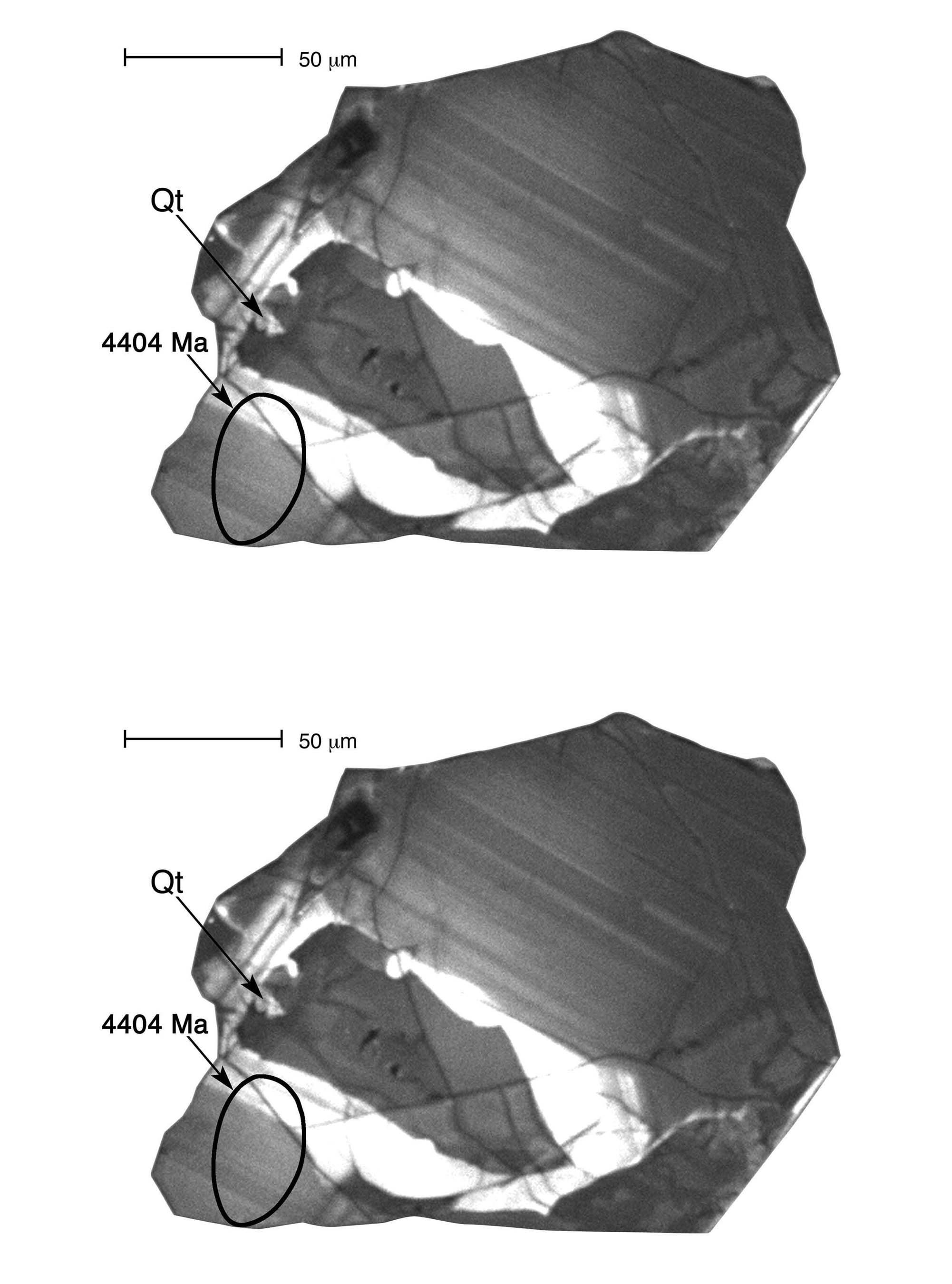
"But zircon?" you scoff. Isn’t that some sort of fake diamond? Actually, it’s sort of a geological time capsule, it seems:
Zircon is a very durable mineral. It is so resistant that zircon often survives weathering and extreme conditions, like those imposed by plate tectonic processes. The mineral usually grows in granite magma, adding layers on its outer surface, so the final product often has a core that is much older than its outer rim. As a zircon crystal grows, it traps unstable radioactive elements like uranium and thorium, among others, in its layers. Zircon is unique in its ability to trap unstable radioactive elements; most minerals are less resistant at the high temperatures of magma. Thus, zircon is the only mineral that can preserve, over long periods of time, the original information it recorded when it formed.
Now I’m sure folks in certain quarters will design some intelligent dismissal of this evidence that the earth is a few billion years older than 6000, but given there’s no monkeys involved in this particular story, they’ll be deprived one of their favorite mockeries, so they may just ignore it.
so they may just ignore it
no way. they’ll have a horde nutbars waving signs and chanting “Hey ho – the Earth’s six thousand years old!”, trying to intimidate people from viewing the awful liberal secularist mineral.
Why does the Earth hate America?
I nominate Sidereal for best use ever of the “Why does ____ hate America?” formulation.
seconded.
thirded, with a guffaw.
I guffawed as well…no, more chortled, I think. Which is more involutary?
Well, my guffaw came from deep down and through an open mouth, really just a louder, longer “heh”. A chortle though is a lot more phlegmy and nasal. Are you still suffering from your cold? 😉
Are you still suffering from your cold? 😉
allergy season.
I’m just digging seeing something geological posted here, I must say.
Age of Rocks. Rock of Ages.
They won’t protest — just snicker about how God made it that way 6,000 years ago, and its just his practical joke to mock non-believers.
The power of faith.
They won’t protest — just snicker about how God made it that way 6,000 years ago, and its just his practical joke to mock non-believers.
The power of faith.
Well, I wouldn’t feel too superior — after all, none of us here (AFAIK) are geologists, we’re just putting our faith in the ability of these scientists to make the determination correctly.
Note that I’m not arguing complete equivalence, just reason for a touch of humility.
I have always wondered why the image of God as a cheap trickster is so popular. God made in the image of Man, perhaps?
…after all, none of us here (AFAIK) are geologists…
A-hem.
(Well, sorta.)
OK, I stand corrected. Guess I should’ve figured that out from the earlier comment, but I thought you were just going for the pun.
kenB: it’s a different kind of faith. I have faith in reason, and no faith in faith.
Put another way, I’m confident that I could, if time allowed, learn the physics, repeat the experiment and would come to the same conclusion. Why? Because of the world around us. Computers work; medication works. Hell, my car runs. If scientists lied on a regular basis, none of this would happen. I have evidence, therefore, that my generic faith in scientific claims is well placed.
Also in my travels I’ve met a bunch of scientists. Except for fellow lawyers, I’ve never met any group more egotistical, arrogant, competitive, jealous and smart. Lawyers who lie and cheat get caught by opposing counsel, lose their cases and get fired. Scientists who lie and cheat get caught by their peers, publicly exposed to humiliation, and get fired.
Priests, on the other hand, seem to have no need ever to enter a library. They only get in trouble if they’re caught bending over a page.
“Priests, on the other hand, seem to have no need ever to enter a library. They only get in trouble if they’re caught bending over a page.”
I thought it was congressmen who were in trouble if they bent over a page. (/cheap joke)
I’m just digging seeing something geological posted here, I must say.
Me too – I enjoy the faintly Moeish air of this post. Ah, memories.
Crap. I’m at the University of Wisconsin-Madison and I didn’t know that! Must make arrangements for a quick viewing tomorrow. Now I just need to figure out where the damn geology department is…
The irony of Francis’ post is fantastic. I think even astrology has as good a track record as my computer working, and my car running isn’t too far behind. I’m with you and those examples still had me chuckling.
Now I just need to figure out where the damn geology department is…
Probably buried in some basement. After all, they are badgers…
After all, they are badgers…
So are we all, LJ. So are we all.
[Football tickets went on sale last week! I’m so pathetically excited!]
Well, I took two entire courses in geology as an undergraduate (science requirement, grr), and it was lots of fun. Funny moment: a friend of mine, one of the least science-y people you’d ever want to meet, for some reason decided to take biology with all the pre-meds, and her lab met at the same time, and in the same building, as mine. One day she came down in the middle of my lab, looking all white; it turns out that they had been asked to cut open mice who were still living, though stunned somehow, and she hadn’t been able to take it. And there was I, doing my lab assignment, which was this: I had a globe and a clear plastic hemisphere that fit over it and a crayon, and I was supposed, by tracing the continents, to reassemple the original supercontinent. Another day we got to run water from a hose over a pile of sand, watching the alluvial processes at work.
Still, I very much liked the field trips, and I will always be grateful to geology for teaching me the wonderful word ‘subduction’, which gives me joy to this day.
Now I just need to figure out where the damn geology department is…
Dig around, Anarch. You’ll find it.
Apologies to all. Shouldn’t have had that last glass of wine.
kenB
I don’t feel superior, but I am not a fan of supplanting rational scientific observations with faith. We live in a time when the “faith-based” argue that people and dinosaurs were contemporaries, based on ????. I think it is proper to debunk such beliefs.
I am a major fan of geology, also. It seems to get less attention these days from the creationists, even though the “theory” of continental drift is based on the same types of inferential evidence and reasoning as the “theory” of evolution.
The science for dating the zircons is fairly ordinary stuff and can be repeated in the lab by others, although its not that simple for the zircons given their small size — its basic science for dating igneous rocks.
Geologists knew beforehand that zircons had the potential to be extremely old. Even after the rock in which they are found (typically granite) is destroyed by erosion, the zircons survive intact only to be incorporated into a sedimentary rock. That is the case for the record setting zircon crystal. The geologist made it a point to look for zircons in very old sedimentary rock that had incorporated zircon crystals from long since eroded granite.
Priests, on the other hand, seem to have no need ever to enter a library.
Wilde nailed that in Dorian Gray:
Even more fun than tomorrow’s geology expo… Madison Slutfest ’05!
Occasional Notes
…this post from Obsidian Wings features the single funniest comment I have ever read in the entire blogosphere. It’s also got a way cool rock sample that’s 4.4 billion years old.
The Catholic church is VERY serious about studying. It has an internally logical, intellectually defensible theology. It’s a remarkable achievement in a way–read some encylicals before you start talking about John Paul II like he’s Pat Robertson.
It’s just that:
1) they’re rigidly hierarchical about it. As you go down the ladder from pope to cardinal to bishop to priest to layman, serious study of theology goes from being regarded as a highly prized virtue to a dangerous temptation into heresy.
2) you can only join this hierarchy if you’re male and willing to take a vow of celibacy.
Well. If you know much about history, this sort of thing has predictable results. We know, in this country, all about what sorts of intellectually and morally indefensible ideas and policies you get about race when schools are segregated and black people are denied the right to vote; what sorts of ideas and policies about sex when women are denied the right to vote; and on and on and on. Intellectual brilliance, and moral imagination, are not any guarantee against this and sometimes it seems like they are no defense at all. Look at the founding fathers, especially Madison, and especially Jefferson.
The difference is, while Madison and Jefferson screwed up badly in many ways, they also designed a system that has proved to be reasonably good at creating opportunities for future generations to correct those errors. The Catholic Church has done the opposite.
There’s a famous quotation from Supreme Court Justice Robert Jackson that “If there is any fixed star in our constitutional constellation, it is that no official, high or petty, can prescribe what shall be orthodox in politics, nationalism, religion, or other matters or opinion or force citizens to confess by word or act their faith therein.”
Well. If there is any fixed star in the Catholic church’s is a theory, based on a highly results-driven reading of a few selectively chosen passages in the gospels, that God has promised to preserve the church from formally teaching as true, something that is actually false. Therefore, it must be obeyed. If you disagree you’re wrong. If you disagree too loudly or publicly you risk the sins of scandal or heresy. The church has moved towards more and more benign means of compelling obedience to the official orthodoxy–with some backward steps along the way, obviously–but obedience is still considered a condition of membership.
The church is infallible when it speaks ex cathedra. And if it screwed up before, it wasn’t speaking ex cathedra, even it claimed to be.
What God has created no man can put asunder, so marriages cannot end. If they end, they were never marriages in the first place.
The closest intellectual parallel in the U.S. that I know of, the closest by far, is the “originalist” approach to Constitutional interpretation. It’s no coincidence that so many originalists are very conservative Catholics–if I remember correctly, Scalia, Thomas, and Bork are all members of Opus Dei.
(N.B.: Liberals, put away your copies of the Davinci Code; conservatives, hold on a sec before you accuse me of being an anti-Catholic bigot or a conspiracy theorisst. I’m not suggesting a sinister conspiracy. All I know is that Opus Dei is a very, very conservative Catholic order that puts a very high importance on not deviating from church orthodoxy. I’m just suggesting that their religious beliefs inform their theories of constitutional interpretation. It’s actually pretty common, and not surprising–lots of people describe Constitutional law as this country’s “secular religion.” Liberal, Vatican II, Kennedy-era American Catholicism had a huge effect on William Brennan and Skelly Wright; I’m sure Judaism had a big effect on Justices Brandeis and Frankfurter. I’m sure being raised by liberal Irish Catholics who came of age during the 1960s has a lot to do with the soft spot I have for William Brennan and Bobby Kennedy. There’s nothing inherently wrong with it. The sort of judge you are will always be informed by the sort of person you are, which will always be informed by the traditions in which you were raised. The difference is, liberal Catholicism & reform Judaism, unlike Opus-Dei style Catholicism, do not claim to be the ONLY legitimate approach to interpreting scripture.)
Originalism, like the jurisprudential theories of the Catholic Church, is a principled an internally consistent theory built on a foundation of sand–a logical error about the difference between meaning-as-definition and meaning-as-application, which they try to hide with a lot of hand-waving about “common law terms of art”. What Scalia’s and Thomas’ and Bork’s originalism really amounts to, is a theory of founders’–state legislatures, early Congresses, and early judges’– infallibility.
If you like the original application (we can do whatever the hell we want to gay people, we can execute children), it’s part of the binding “original meaning of the text” because it’s clearly a “common law term of art” & deviating from it is heresy. You are not just a bad judge, you are not a judge at all. Of course Scalia can’t actually excommunicate the liberal and moderate justices, but you get the unmistakable sense from the unrelenting hostility of his dissents that he’d do it if he could.
If you don’t like the original application, (legal segregation is permitted, anti-miscegenation laws are permitted), it’s because the original application contradicts the “clear text” of the constitutional provision. So supposedly segregation and anti-miscegenation laws are not allowed because the “clear text” of the 13th and 14th amendment prohibits any racial classifcation. Not that the word “race” actually appears in either amendment, mind you–it’s just that the historical context makes it clear that “equal protection” is a “term of art” meaning “no racial classification is permitted”. How does the historical context prove that it’s only about race, but not that it’s only protecting certain races or preventing certain forms of discrimination, is never explained.
And if you disagree, you’re not just a bad judge. You’re not a judge at all. You’re a “judicial activist” who’s “legislating from the bench”.
For further illustrations of this kind of thinking in action, applied to Constitutional law, religion, & lots of other stuff too, see Southern Appeal and several of the posters on RedState.
They’re not arguing this in bad faith. They’re completely, honestly, unalterably convinced that this is the only true path to salvation, and the only legitimate way to interpret the Constitution. But they’ve mistaken the Pope for the Church, and the Church for God. They’ve mistaken their own selective, results-driven reading of the penal codes of 13 colonies for the ratifiers’ intent, and the ratifiers’ intent for the meaning of the Constitution. They honestly think they’re trying to show us the only escape from judicial tyranny or eternal separation from God, when they’re really trying to drag us back 300 years to a time when certain sorts of people knew their place.
When I say “trying” to drag us back 300 years:
1) I am not saying that this is their conscious or even their subconscious intent. I am saying that this would be the effect of their decisions, and that if they weren’t okay with this effect at some level, they would be able to spot the flaws in their theory. This is why ALL judges’ decisions are affected by their ideology: you can spot an error in the reasoning of an argument you disagree with, more easily than you can spot an error in the reasoning of an argument you agree with.
2) Also note that this does not apply to race to the same extent as gender, because of the historical context of the 13th, 14th, and 15th amendments and the widespread social consensus about Brown and Loving, and probably also because the Catholic church has it’s head on much straighter about race than about gender.
3) If you think I’m accusing of Clarence Thomas of Uncle Tom-ism–no, I am not, that would be pretty idiotic for someone as white as me. Thomas, for reasons I’m obviously not qualified to speculate on but which I would guess involve a strong dislike of what he sees as being condescended to or to “the soft bigotry of low expectations”, seems to strongly oppose the most common and controversial government remedies for racial discrimination–e.g. affirmative action, majority minority districts, judicially imposed integration, a.k.a. “forced busing”. So his desired result is often the same as, oh, Trent Lott’s, but it is not only possible but likely that his motivations are different. I could easily be wrong about any of this.
4) If this applies more to questions of gender than questions of race, it applies most of all to gay people, poor people, immigrants, and criminal defendants.
correction: they’re not members of Opus Dei. I LEXISed
to make sure, and I’d misremembered–I didn’t find any credible reports that they were. As I said, I didn’t see any significance in Opus Dei membership other than as evidence that Scalia was raised a very traditional, conservative Catholic & I think there are a lot of structural parallels to his theory of originalism & the Catholic Church’s teachings on infallibility, divorce, etc. And he definitely is a very conservative Catholic–he goes to a church with Latin Mass, his son’s a priest, etc.
Clarence Thomas and Robert Bork are also very conservative Catholics, but they actually converted to Catholicism as adults. In Thomas’ case, Justice Scalia’s son Paul, who’s a Catholic priest, converted him. In Bork’s case his wife, who served as a nun in a traditional order for many years, convinced him to convert. So they were originalists before they were Catholics. I don’t think this really refutes my theory, which is that these are very structurally similar theories of jurisprudence–in both their appeal (a promise of certainty), their logical flaws (one of the key assumptions is an unrefutable tautology that is used in a totally results-driven manner), and their policy effects (an escape from the messy debates of recent times to an older, “purer”, more authoritarian age.)
kenB: humility’s fine; pandering to unprovable views isn’t. Equivalence is ridiculous here. You say you have to have faith in the scientists. That’s true. However, the scientists could, in theory, guide you through it logically from very simple premises. They could make a reasoned argument. The 6000 year-old earth crowd couldn’t possibly do that. They could only appeal to your emotions and general feelings.
Whenever I’m reading a comment here that seems incredibly well-researched, thoughtful, thorough, intelligent and germaine, with a vein of logical reasoning that never once becomes fuzzy or indistinct, it always turns out to have Katherine’s name at the bottom.
Re: scalia in opus dei
US News and World Report says that Scalia is “perhaps” a member. Still uncertain, but a little better than Counterpunch.org.
tync: she’s a law student. Her posts aren’t a spare time thing for her; it’s practice!
(ok, i’m jealous. I think Katherine’s a great writer and a deep thinker. This is a powerful combination for a budding atty.)
The idea that the clergy is inclined to ignorance is a false one. What’s more the case is that the clergy is inclined to selective ignorance, otherwise known as blinders. My pastor can read and translate Greek, Hebrew and Aramaic. There is a drive to learn behind that knowledge, just not in a direction that can be considered consistent with scientific inquiry. I’ve discussed with my pastor the apparent conflict between Biblical account and scientific data, and which he’d believe. His answer and mine are different. See, my problem is that I can’t make myself buy that fossils and rock stratification are artifacts of the post-Flood era.
I just can’t.
Oh, and here’s an encapsulation of the whole zircon issue as posted at talkorigins.org. Featured prominently in the discussion is one “Dr.” Kent Hovind, who, despite Brad DeLong’s assertions to the contrary, is a shoo-in for the “stupidest man alive”.
Let me tell you, when your own relatives start handing you videotapes of this guy as if he’s got any sort of valid point, it makes you want to sit down with them and drag them kicking and screaming through the eye of a college education.
I agree with Slart — the clergy are not, in general, inclined to ignorance. Nor is there any reason at all to think that Christianity conflicts with science, unless you think that the Bible must be read literally, in which case you need to toss out not just evolution and carbon dating, but a heliocentric view of the solar system. (And there are alternatives to total literalism which are, imho, completely defensible. And I thought the same when I was a very serious Christian.)
It’s one of the things that really bugs the ex-Christian in me: Christianity has a wonderful intellectual tradition, and for most of its history the idea that Christianity and reason were in conflict just didn’t cross people’s minds. Thus, Christianity was never defensive; it was curious and perceptive and intellectually rigorous. But now its most vocal members seem to have surrendered all this, and decided that reason and science are their enemies.
Among other things, this seems to me to involve a very odd view of God: why did he give us reason, and make us as inquisitive as we are, if reason just leads us astray, and we are not supposed to use it? This is of a piece with the idea that God created fossils, rocks that carbon dating ‘shows’ to be billions of years old, etc., just to mislead us. That’s not like the God I used to worship.
The idea that the clergy is inclined to ignorance is a false one.
Although I offered the Wilde quote mostly for its entertainment value, I do think this idea could be clarified somewhat. First, different religions have different traditions here, so blanket assessments are not possible. Second, until very recently, those sent out to the furthest corners of the earth to preach did’t have the same access to additional learning those in major centers did, so despite the best intentions, the missionary aspects of many Christian traditions fossilized whatever knowledge they had when they set out. Surely some continued to study as best they could in their new surroundings, but Wilde’s point about repeating the same thing for their rest of their lives was more likely the rule rather than the exception for many, no?
” for most of its history the idea that Christianity and reason were in conflict just didn’t cross people’s minds.”
Well….we’d need to set aside old “credo quia absurdum” Tertullian, who was known to the Church for all but 200 or so years of its history. And Clement, who liked to get in the odd “Jerusalem vs. Athens” dig at rational philosophy. Paul in Romans is probably the template for this blowing hot and cold on reason.
But on the whole I agree with you; the traditions of the church throughout most of the last few millenia have not been as starkly and brazenly irrationalist as the current crop of social-conservative fundamentalists and theocrats are.
Sometimes anti-empiricist (cf. Galileo), but not fundamentally anti-reason, and often wonderfully rigorous (there’s a reason that endless nit-picking and distinction-mongering is called “Scholastic”).
Though often, as Katherine points out above, the church has reserved the luxuries of subtlety and rigor only for the heights of the hierarchy, and enforced crude and blunt approximations on the footsoldiers of faith.
Ah yes, the false evidence-dodge vis a vis fossils. When people suggest that God could have cooked up all of the fossils in order to lead us into the Devil’s parlor, I always want to counter that God could just as easily have created the false scriptures known as the “Old Testament” and “New Testament” as a way of luring us into sin and heresy. If they can holler “fake!”, we can reply with Blake.
Or that God could have created the entire universe five seconds ago, along with your memories of your life. Once you wave the miracle wand, it’s hard to know when to stop.
ooh, that’s easy: stop once you’ve got the pony!
paraphrasing Schopenhauer on proofs of the existence of God:
these proofs treat causality like a hired cab that one can take as far as one’s destination and then dismiss at will.
As gemstones go, zircon is actually rather soft. Its not the greatest stone for rings, but it works well in earrings, pendants, etc. Basically anything but rings. Its a very bright stone.